

OUR NATUROPATH TELLS YOU ALL ABOUT IT!
Growing antibiotic resistance: A major issue and the essential oil alternative
The growing resistance of bacteria to antibiotics represents a major global challenge, which is driving research towards identifying new biomolecules with broad antibacterial activity. Plants and their compounds, such as essential oils, are commonly used in traditional medicine.
WHAT ARE THE MAIN CHARACTERISTICS OF ESSENTIAL OILS? ARE THEY REALLY NATURAL ANTIBIOTICS?
Yes! Essential oils have strong anti-infectious, antiseptic, and antiviral properties. They are an alternative to antibiotics and have largely proven their effectiveness. Moreover, their capabilities go far beyond: they are analgesic, healing, anti-hemorrhagic, digestive, regulate immunity and hormones, eliminate infiltrated fats, and strengthen blood vessels... Each essential oil has specific roles and, for the most part, multiple activities.
Some essential oils are particularly "antibiotic," although it is more accurate to call them "antiseptic" because, unlike antibiotics ("against life"), they do not destroy our beneficial flora.
They have been used for their "antibiotic" properties in warm countries, where traditional dishes are very spicy: the essential oils of spices inhibit the microbial development of food. For millennia, essential oils have been used by fumigation or friction. In 1887, Chamberland scientifically proved that essential oils of oregano, clove, and cinnamon possess antibiotic properties against Bacillus anthracis (the anthrax bacillus), with surprising results.
In aromatherapy, numerous studies show the effectiveness of essential oils against common and aggressive microbes such as diphtheria, typhoid, and streptococci. Essential oils can effectively combat many formidable germs.
MAJOR DIFFERENCES BETWEEN ANTIBIOTIC DRUGS AND ESSENTIAL OILS EXPLAIN THE INTEREST OF ESSENTIAL OILS.
- Absence of antibiotic resistance: According to the WHO, some antibiotics will no longer be effective in 10 to 20 years due to their prolonged, misuse, and overuse. Essential oils, however, do not lose their effectiveness over time. Their extreme diversity prevents microbes from developing resistance.
- Antiviral properties: Most essential oils are also antiviral. Their preventive antibiotic effect can prevent superinfections, for example, by treating flu or colds to prevent bronchitis or sinusitis.
- Modification of the microbial environment: Essential oils disturb the environment of germs, making their survival difficult, in addition to disrupting their organic and metabolic processes.
- Efficacy at low concentrations: Essential oils are effective at much lower blood concentrations than antibiotics and destroy a large number of different bacteria, unlike traditional antibiotics.
- Stimulation of the immune response: Essential oils prevent the proliferation of germs while stimulating the immune response, which prevents disease recurrence. Classic antibiotics, on the other hand, kill both positive and negative bacteria. The same applies to most winter ENT and respiratory ailments. Essential oils offer a fast, effective, and side-effect-free solution to antibiotics.
- Rapid disinfection: Vaporizing or diffusing essential oils can disinfect a room in less than 10 minutes.
Aromatherapy can also be combined with traditional antibiotics to strengthen their effects and achieve faster and more lasting results.
INTERESTING STUDIES ON THE ANTISEPTIC EFFECT OF ESSENTIAL OILS.
Researchers already understand the enormous potential of aromatherapy, and very convincing experiments show that aromatherapy can purify hospital surfaces (floors, tables, beds) and air, thereby reducing the risk of hospital-acquired illness ("caught on site"). They could be used as a replacement for current disinfectant products, which are either very toxic (so toxic that they must be used without human presence) or moderately effective, and against which microorganisms can develop.
- University of Manchester, United Kingdom: Studies show that essential oils can completely disinfect a room (leaving no living bacteria behind!), including the most concerning microorganisms such as methicillin-resistant Staphylococcus aureus (MRSA) and other multi-resistant germs like Pseudomonas aeruginosa, and other enterococci like the famous Clostridium difficile, and even E. coli.
- Reduction of dust mites and molds: Researchers suggest that hospital staff could use the most disinfectant essential oils (shampoos, soaps, body cleansers, disinfectant products, etc.) to stop "epidemics"2. Essential oils eliminate between 57% and 100% of dust mites, molds, fungi, bacteria, and viruses3 in two minutes.
- Prevention of acute bronchitis: Taken orally, they reduce the number of acute bronchitis in patients regularly suffering from bronchitis4.
- Limiting microbial proliferation in hospitals: They can limit the proliferation of fungi and microbes before their numbers reach thresholds indicating poor air quality5.
SOME EXAMPLES OF ANTI-INFECTIOUS ESSENTIAL OILS
QUEBEC ESSENTIAL OILS6
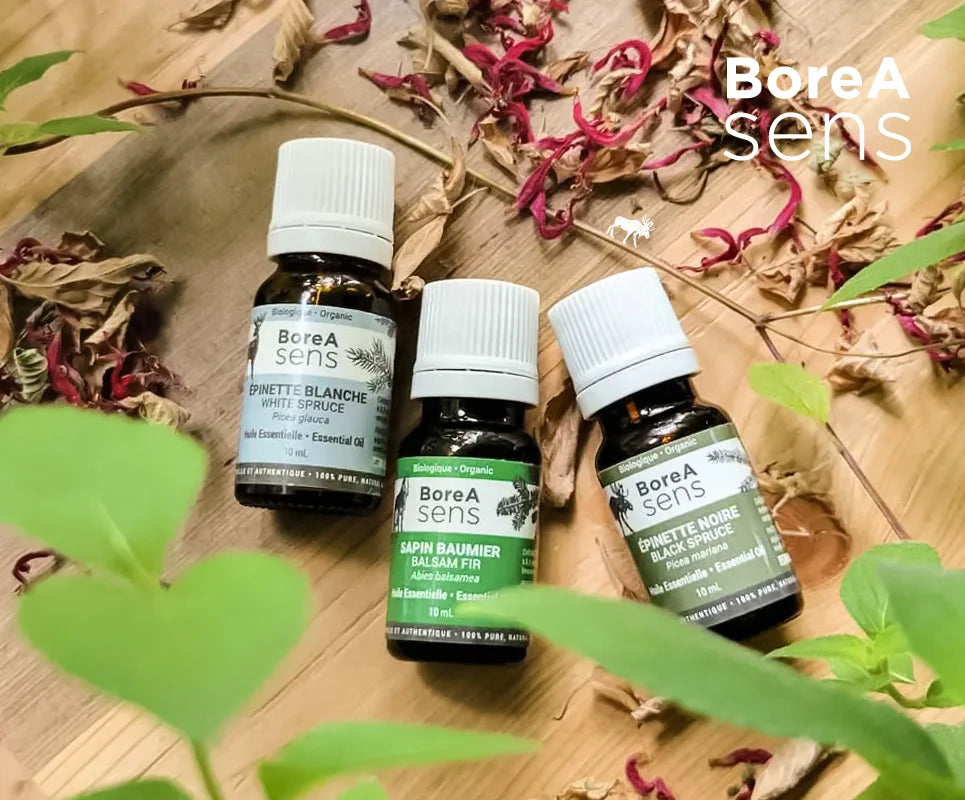
- Balsam Fir EO (Abies balsamea) and Black Spruce EO: Antiviral properties, help fight colds and flu.
- White Spruce EO (Picea glauca): Antibacterial and immunostimulant properties.
- Common Juniper EO (Juniperus communis): Antiseptic properties for the renal and urinary tracts.
WORLD ESSENTIAL OILS
- Oregano EO (Origanum vulgare)7: Due to its high carvacrol and thymol content, oregano is a powerful natural antibacterial agent. It is effective against bacteria that cause respiratory, urinary, and skin infections... even multi-resistant strains!
- Tea Tree EO (Melaleuca alternifolia)8: Originating from an Australian tree, it is an excellent broad-spectrum antibacterial, particularly against germs responsible for skin infections such as acne, mycoses, abscesses, and boils, as well as canker sores and gingivitis. It is also a perfect essential oil to combat winter viruses and microbes such as sore throats and coughs. Its secret is the synergy of its active molecules including Terpinen-4-ol, Gamma-terpinene, Alpha-terpinene, and Limonene.
This article offers advice and is in no way a substitute for medical advice or a prescription. Its purpose is not to prevent you from consulting your doctor or stopping your treatment.
References
*MY ESSENTIAL OILS BIBLE (DANIELE FESTY)
1 - A. Bouyahya et al., "Antibiotic resistance and mechanism of action of essential oils against bacteria," Phytothérapie, December 2018.
2 - Jacqui Stringer, Clinical Lead of Complementary Therapies at Manchester’s Christie Hospital, 2004.
3 - Puressentiel study/spray with 41 essential oils/Strains provided by the Pasteur Institute of Paris.
4 - Study of essential oil drops, Prof. Dalphin, Head of Pneumology Department at Besançon University Hospital.
5 - PhD thesis by Dr. Gisèle de Billerbeck "Microbiological air sanitation and ventilation systems using essential oils," EPFL 2005.
6 - Nobles essences, guide des plantes aromatiques et huiles essentielles du Québec (STEPHANIE PLAMONDON).
7 - Dominique Laurain-Mattar et al., "Essential oil of Origanum vulgare," Actualités Pharmaceutiques, October 2022.
8 - Dominique Laurain-Mattar, Françoise Couic-Marinier, "Tea Tree essential oil," Actualités Pharmaceutiques, February 2019.


